
The NCCHW is a member institution of the Health Policy Research Consortium (HPRC).
Established in 2024, the Health Policy Research Consortium (HPRC) works collaboratively to develop and implement a shared research agenda addressing factors that influence health in WNC. The Dogwood Health Trust launched HPRC to better understand and respond to the needs of people and communities in Western North Carolina. At UNCA, HPRC works in close collaboration with the WNC Health Policy Initiative (HPI), hosted by NCCHW, to coordinate research and sharing opportunities that can inform policies and improve health. HPRC also works in alignment with NCCHW’s Culture of Results (CoR)Initiative by conducting rigorous, community informed research.
HPRC Member Institutions
Member institutions include: Appalachian State University, East Tennessee State University, University of North Carolina Asheville, Western Carolina University, and the WNC Health Network.
HPRC Priority Areas & Research Agenda
HPRC focuses on four priority areas: food security, housing, mental health, and substance use. The priority areas were identified by consortium members, based on:
- consultation with community advisors and partners,
- data collected in the regional Community Health Assessment, ● existing and potential policies
- HPRC member research expertise
The research agenda and questions are in development. Institutions will pursue independent and collaborative research. At NCCHW, we conduct regional and local research in partnership with communities and organizations.
HPRC Vision, Mission, Values
Vision: Resilient, thriving, and just communities throughout Western North Carolina with equal opportunity to access health and wellbeing
Mission: The Western North Carolina Health Policy Research Consortium leverages research and evaluation resources, nurtures capacity and innovation, and finds creative solutions with community partners to inform policies that improve health outcomes for the people in WNC.
Values:
- Collaboration – listening with humility, curiosity, and respect as we foster relationships and build partnerships to advance this work ● Community-Driven – including and amplifying community voice and recognizing that community members are experts of their own lived experience
- Justice – intentionally working towards ensuring power and systems that work for everyone
- Open Communication and Transparency – sharing of data, findings, and challenges openly and honestly
HPRC Governance and Structure
Co-Collaborator Model – Each of the five institutions has one lead and one or two co-collaborators.
Advisory Committee (AC) – The AC is comprised of 10-12 individuals who generate ideas, act as a sounding board, and offer advice and suggestions for the HPRC to consider and incorporate into final decisions. Advisory Committee members hold the HPRC accountable to its values and achieve its vision. (see Image 1)
Consensus – The HPRC strives to reach consensus in decision-making.
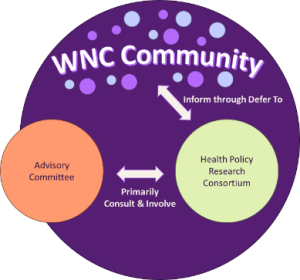
2024-25 HPRC Activities
- Convenings: From June 2024 to October 2025, 13 convenings were held to form and sustain the HPRC.
- Membership expansion: HPRC grew from five organizational leads to 15 participants (one lead plus two collaborators per organization).
- Advisory Committee development: The Advisory Committee (AC) role and expectations were discussed and HPRC members nominated, discussed, and approved AC member invitations. The 10-member AC was convened for two in-person meetings in May and September 2025.
- Vision, mission, and values: HPRC members developed and finalized the consortium’s vision, mission, and guiding values through a collaborative process.
- Decision-making and group agreements: HPRC adopted a decision-making pathway that prioritizes consensus where possible and ensures space for diverse perspectives when consensus is not initially reached.
- Defining the Research Agenda: The HPRC has advanced to a focused research agenda with clearly defined research priority areas. HPRC undertook a structured prioritization process to narrow potential priority areas against agreed criteria: alignment with HPRC vision, mission, and values; a community-identified priority; presence of disparities or data gaps; potential to influence health policy; feasibility; and member interest or expertise.
- Strategic Planning: In October 2025, HPRC members reviewed the purpose and value of an organizational strategic plan for HPRC.
More Information
See examples of HPRC’s work soon, on our Collaborative Research page.
Contact
Emma Olson, MSW, MPH
HPRC Lead, UNC Asheville
Interim Executive Director, NCCHW
eolson1@unca.edu